
Spotting the red flags: New campaign launched to help people recognise the warning signs of domestic abuse
Main article content

A major campaign using the experiences of victim-survivors to raise awareness of the red flags of domestic abuse, specifically coercive and controlling behaviour, is launching across Merseyside today (Thursday 24 April), as part of an ongoing commitment to tackle Violence Against Women and Girls.
Domestic Abuse can affect anyone regardless of ethnicity, age, gender, sexuality or social background. It can take many forms and often begins with subtle behaviours that, at first, may appear charming, attentive, romantic and supportive. Abusers often don’t show their real selves until they have completely gained their partner’s trust. The abuser ultimately wants to gain power and control over the person they are supposed to love. This is Coercive Control. This is Domestic Abuse.
Coercive Control is a form of Domestic Abuse. It is designed to make a person dependent on the abuser by isolating them from friends and family, controlling their movements, making threats or intimidating them, anything that harms, punishes or frightens their victim.
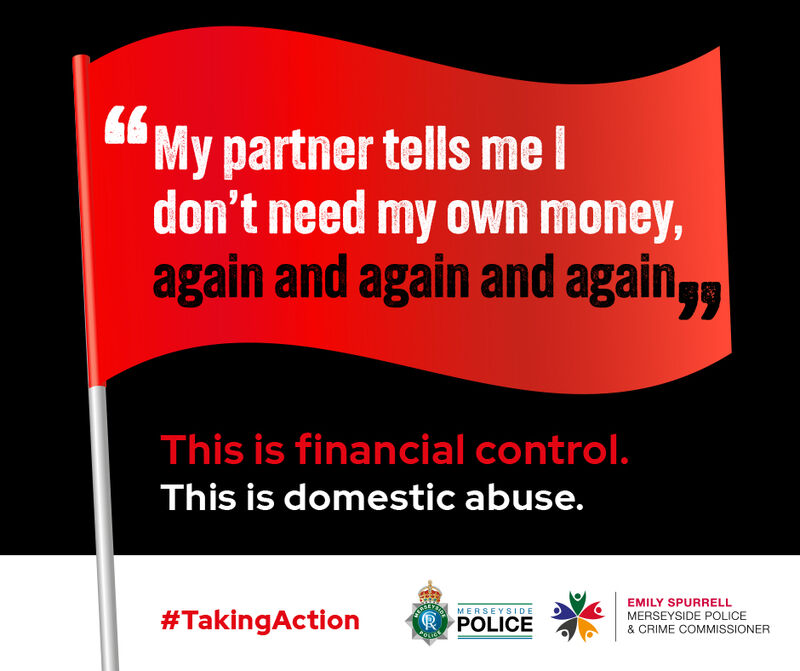
Today’s launch marks the second phase of the ‘Taking Action’ campaign launched by Merseyside Police and Merseyside’s Police and Crime Commissioner, Emily Spurrell, last September.
Informed by the voices of victim-survivors with lived experience, the campaign aims to raise awareness of behaviours that are often overlooked or minimised in relationships, but which are often warning signs of domestic abuse. It is designed to reach victim-survivors and their friends and family to enable them to spot the ‘red flags’ so they can confidently report it to police at the earliest opportunity and seek help.
Created in consultation with victim-survivors at specialist domestic abuse service ‘The First Step’ based in Knowsley, the campaign will reach Merseyside’s communities via digital advertising platforms including radio and podcasts, roadside kiosks, bus advertising, posters on rail and bus networks courtesy of Merseyrail and Merseytravel, leaflets and advans, alongside social media advertising and other platforms.
The powerful marketing and visual campaign has been designed to support the relentless and proactive work being undertaken by Merseyside Police, the Police and Crime Commissioner (PCC) and their partners to tackle Violence Against Women and Girls, bring perpetrators to justice and to support anyone impacted by domestic abuse.
Detective Chief Superintendent Paul Lamb, Head of Protecting Vulnerable People Unit, said: “We want to help people to recognise the red flags of domestic abuse and how to spot the signs. This is the whole premise of the campaign.
“Perpetrators of domestic abuse are manipulative. They will go to significant lengths to gain their partners trust before swiftly turning their homes into a place of fear and abuse.
“Sadly, many of those who suffer at their hands do not recognise themselves as victims. This is why it is imperative we highlight the signs through this campaign and encourage people to seek support and make a report when they feel ready.”
Detective Chief Superintendent Lamb added: “I also want to encourage friends, family members and the wider community to come forward and make a report if they suspect someone is suffering from domestic abuse. If you’re worried about someone, let them know you’ve noticed something is wrong. They might not be ready to talk but try to find quiet times when they can talk if they choose to.”
Police and Crime Commissioner, Emily Spurrell said: “Perpetrators of domestic abuse will do everything possible to normalise their controlling and coercive behaviour.
“This campaign is focused on emphasising these behaviours are neither normal or loving, but manipulative and abusive.
“By working with brave victim-survivors and the brilliant local charity, The First Step, we are highlighting some of the key warning signs to help victims and their families and friends to recognise when relationships have become abusive.
“We want to give people the confidence to reach out for help and support if they have concerns.
“Merseyside Police has officers and staff who are trained to support you. If you don’t feel confident speaking to police, there are a host of specialist organisations across Merseyside on hand to help, all of which can be found at my www.victimcaremerseyside.org website.
“By reporting your concerns at the earliest opportunity, action can be taken to prevent incidents from reoccurring or escalating and ultimately keep victims safe.
“Alongside senior leaders across Merseyside, the Chief Constable and I have pledged to tackle violence against women and girls across Merseyside, and this second phase of our partnership campaign demonstrates our commitment to Taking Action against gender-based violence and to ensure victim-survivors know support is always available to them.”
Jenny Dennett Community Domestic Abuse manager, The First Step, Knowsley said:
“At The First Step, we believe that those who have lived through Domestic Abuse and coercive control are not just survivors, they are experts. Their voices, insights, and lived experience are vital in the fight to end domestic abuse. That’s why we are proud to have supported this campaign, which places survivors at the centre, where they belong.
“It is of utmost importance that individuals who have experienced coercive control, a profoundly harmful and often hidden form of abuse, are given a platform to share their experiences. Many survivors were unaware they were in an abusive relationship until long after the fact. Their lived experience uniquely positions them to inform professionals about the warning signs, patterns of behaviour, and red flags associated with coercive control. By amplifying their voices, we can raise awareness, encourage more victims to come forward, and ultimately save lives."
As well as this new public-facing campaign, a wide range of proactive measures and projects are being put in place focused on #TakingAction on domestic abuse. This includes:
- The launch of a new dedicated team within Merseyside Police focused on targeted high-risk perpetrators of domestic abuse and sexual violence.
- Independent Domestic Violence Advisors (IDVAs) joining police officers when they respond to a domestic abuse call to provide specialist support to victims.
- More than £1.2m being awarded by the Police and Crime Commissioner to 16 local organisations to provide community-based support to victims of domestic abuse over the next year.
- An extra £400,000 being secured by the Police and Crime Commissioner to deliver an early intervention programme focused on protecting families by acting early to tackle abuse behaviour.
- A regional review of domestic abuse funding commissioned by the PCC and being undertaken by Women’s Aid and LJMU which will map the provision available, capacity and demand within those services to inform how resources are used to best support the people who need it the most.
- Engaging and involving women and girls in forums and lived experience workshops so we are better placed to understand and tackle violence and intimidation they face, whilst at the same time providing them with support
- Rolling out Domestic Abuse Matters training to more than 1,500 frontline police officers. This cultural long-term change programme, developed by SafeLives and the College of Policing, focuses on enhancing the existing skillsets of frontline officers to ensure we are providing a consistent level of service to those experiencing domestic abuse in our communities.
- Rolling out trauma informed training to all police officers and staff focussed on giving attendees a greater understanding of how psychological trauma can impact on individuals and to assist when dealing with challenging and sometimes distressing situations. The key learning objectives from the training are:
- Understand vulnerability and the impact of trauma
- Recognising feelings
- Building trust and how to respond to a crisis
- Piloting a virtual policing response which is available to victims of domestic abuse. Victims can speak to an officer online, receiving the same service as they would if an officer attended in-person. This service involves:
- the reporting of any crime
- completion of a risk assessment
- receiving safeguarding advice
- investigative steps needed to advance the case
- Ensuring we are conducting checks to see if there is a protective order in place when dealing with perpetrators
- Carrying out regular strike days to target perpetrators of domestic abuse
For more information, please visit: www.merseyside.police.uk/VAWG
